


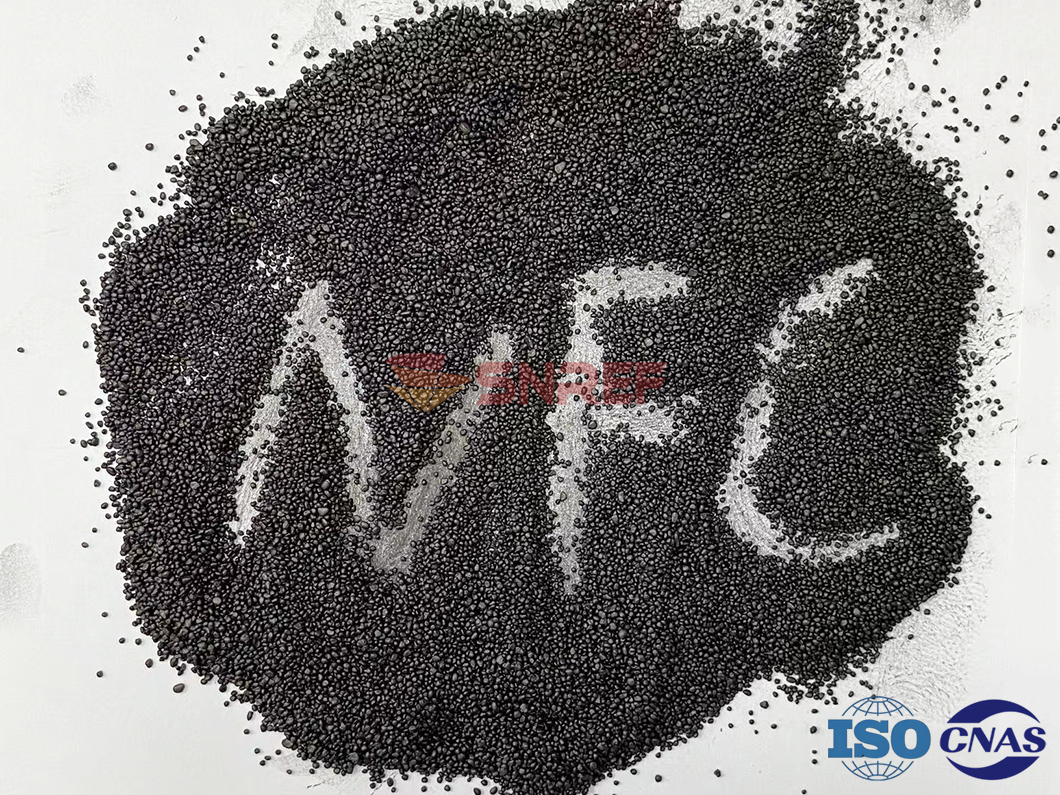
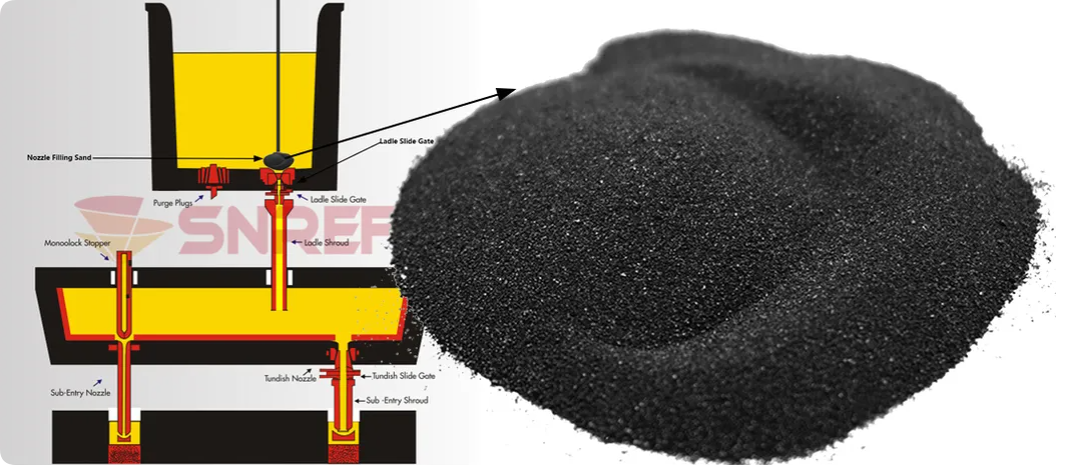
In continuous steel casting, a failed or delayed opening of the ladle sliding gate can cause serious production losses. This is where Nozzle Filling Sand (NFC) – also called nozzle filling compound or stuffing sand – becomes essential. Placed inside the ladle nozzle, NFC guarantees automatic and smooth opening during steel teeming, prevents clogging, and improves molten steel flow control.
Based on real-world ongoing shipments of high-quality NFC, this article explains its two main types (silica based and chromite based), the manufacturing process, and why reliable supply matters for steel plants.
WHAT IS NOZZLE FILLING SAND (NFC)?
Nozzle Filling Sand is a specialized refractory material placed in the upper nozzle of a steel ladle before casting. When the slide gate is opened, the sand flows out naturally due to gravity and the pressure of molten steel, ensuring an automatic, clog?free start of the teeming process. Without proper NFC, the nozzle can become blocked by solidified steel, leading to manual oxygen lancing or even aborted casts.
TWO MAIN TYPES OF NOZZLE FILLING SAND
Choosing the right type of NFC depends on steel grade, holding time, and temperature. The two most common categories are:
Silica Based
Cost?effective, good flowability, suitable for moderate temperatures
Typical application: Plain carbon steels, short holding time
Chromite Based
Higher density, excellent refractoriness, lower thermal expansion
Typical application: High?grade alloy steels, long ladle holding time
For most steel plants, a well?balanced chromite based nozzle filling compound offers the best reliability under severe conditions.
MANUFACTURING PROCESS OF NOZZLE FILLING SAND
Consistent quality of NFC begins with a tightly controlled process. The standard workmanship includes four steps:
Batching – Accurate proportioning of silica sand, chromite sand, and additives.
Mixing – Homogeneous blending for uniform particle distribution.
Drying – Removing moisture to prevent steam?related explosions during casting.
Packing – Sealed, moisture?proof bags ready for shipment.
Each step directly affects the sand’s flowability, sintering behavior, and resistance to steel penetration.
WHY ONGOING SHIPMENTS AND RELIABLE SUPPLY MATTER
Steel plants cannot afford unexpected shortages of nozzle filling sand. Image content from real operations shows continuous shipments of NFC with reliable quality, steady supply, and on?time delivery. These three factors are critical because:
A sudden change in sand quality can cause clogging or delayed opening.
Late delivery directly impacts casting schedules and downstream rolling.
Steady supply ensures consistent steel flow control across heats.
Therefore, choosing a supplier that demonstrates ongoing shipments of proven NFC is as important as selecting the right sand type.
Looking for a reliable source of Nozzle Filling Sand? Contact us to discuss your ladle conditions and get samples from our ongoing shipments.
Susan LIU
General Manager
Mobile(WhatsApp): +86 153 188 077 07
E-mail: Susan@sinorefractory.com


